🚀 Introduction
If you’re new to web development, you’ve probably heard the terms frontend and backend.
But what do they actually mean?
This guide explains the difference in a simple, non‑technical way so even complete beginners can understand how websites and apps work behind the scenes.
You’ll learn:
- What frontend and backend development actually do
- How they work together
- Real examples from everyday web services
- Which one you might want to learn first
✅ What Is the Frontend?
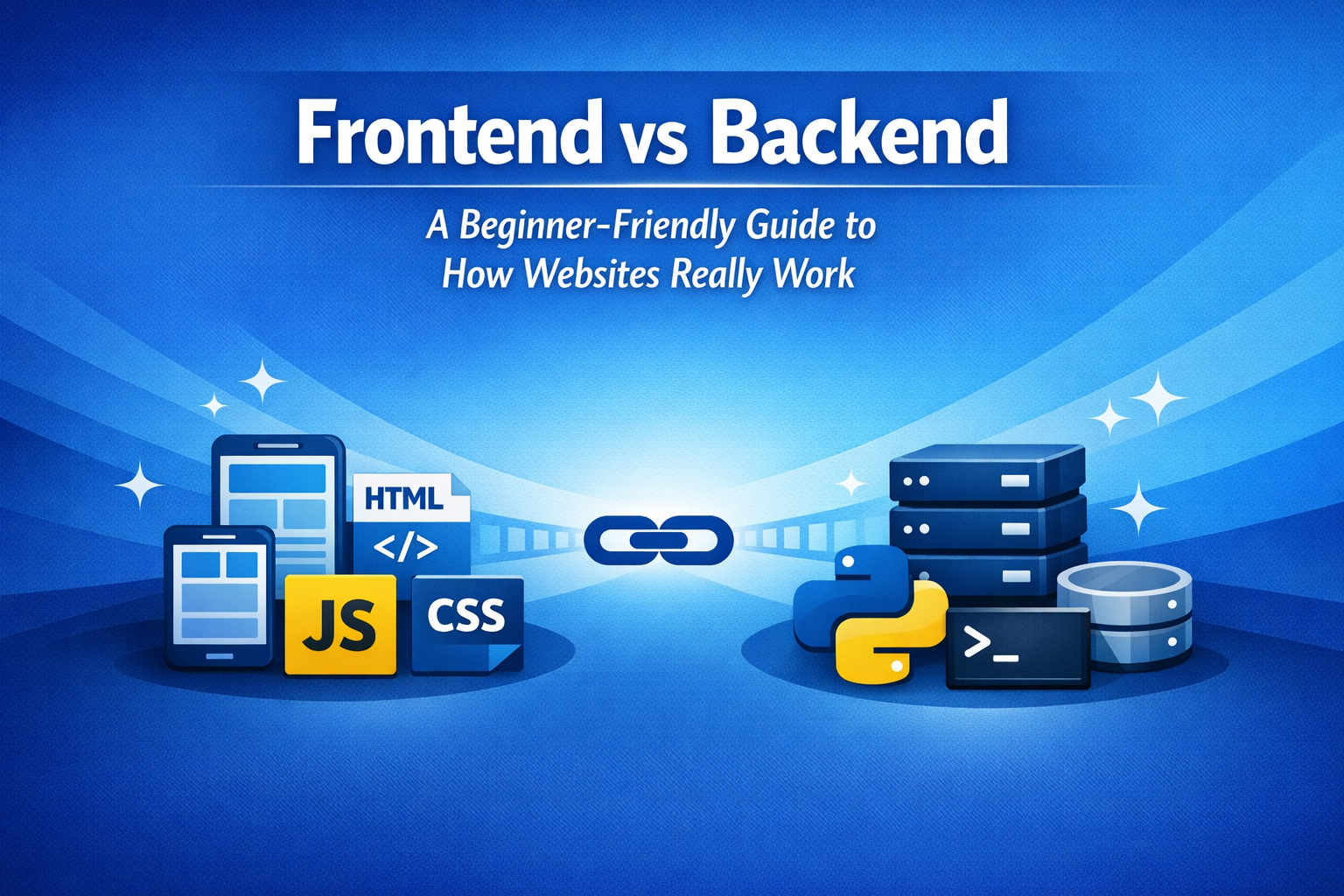
The frontend is everything users can see, click, and interact with.
Examples include:
- Website layout and design
- Buttons, animations, and transitions
- Responsive layouts that adapt to smartphones
Common technologies: HTML, CSS, JavaScript
A helpful analogy:
The frontend is like a store’s interior, menu, and customer service.
It’s the part customers directly interact with.
🧠 What Is the Backend?
The backend is the “brain” of the application—processing data and powering features behind the scenes.
Examples include:
- Login authentication
- Saving and loading data from a database
- Order processing and calculations
- Security and access control
Common technologies:
Python, PHP, Ruby, Java, Node.js, SQL databases
Analogy:
The backend is like the kitchen, storage room, and cash register system.
Users don’t see it, but nothing works without it.
🧩 Why Both Are Necessary
- Without a frontend → the screen is blank
- Without a backend → the site looks nice but nothing works
A real web service needs both:
Frontend = visible interface
Backend = invisible engine
Together, they form a complete, functional application.
🌐 Real‑World Examples
Blogs & Company Websites
- Frontend: page layout, typography
- Backend: storing and managing article data
Online Stores
- Frontend: product list, cart page
- Backend: inventory, order processing, payment handling
Social Media
- Frontend: posting UI, timeline
- Backend: saving posts, notifications, user data
Web services are essentially teamwork between frontend and backend.
💡 Tips, Trivia & Modern Trends
1) Frontend Has Become Much More Complex
Early websites were mostly HTML.
Today’s frontend involves animations, app‑like interactions, and responsive design—almost like building mini‑applications.
2) Backend Is Invisible but Critical
If the backend goes down, SNS, online shops, and apps all stop working.
It’s the backstage crew that keeps the show running.
3) The Line Between Frontend and Backend Is Blurring
With modern tools, frontend developers can handle backend‑like tasks, and vice versa.
This is why full‑stack developers are becoming more common.
4) Neither Role Is “More Important”
Asking which is superior is like asking whether kitchen staff or servers are more important.
Both are essential.
📚 Useful Resources
Official Docs & Learning Sites
- MDN Web Docs (Frontend basics)
https://developer.mozilla.org/ - W3Schools (HTML/CSS/JS basics)
https://www.w3schools.com/ - Python Official
https://www.python.org/ - PHP Official
https://www.php.net/ - Node.js Official
https://nodejs.org/
Wikipedia
🛠️ What to Learn Next
- HTML / CSS / JavaScript basics
- What APIs are (how frontend and backend “talk”)
- Database fundamentals (SQL)
- Git / GitHub for version control

Coming Soon

Coming Soon
- Deploying static sites with Hugo + Cloudflare Pages
🎯 Summary
- Frontend = visible design & interactions
- Backend = invisible logic & data processing
- Both are essential for modern web services
- Beginners can start with either path
- Learning HTML/CSS/JS or APIs is a great next step